2025 paper · walkthroughs
Worked Examples
The 2025 exam, taken apart. For each of the three questions: one real quotation unpacked, thesis options, a paragraph-by-paragraph plan, and what the examiners' own report said about how candidates handled it. Read with the 2025 question booklet open.
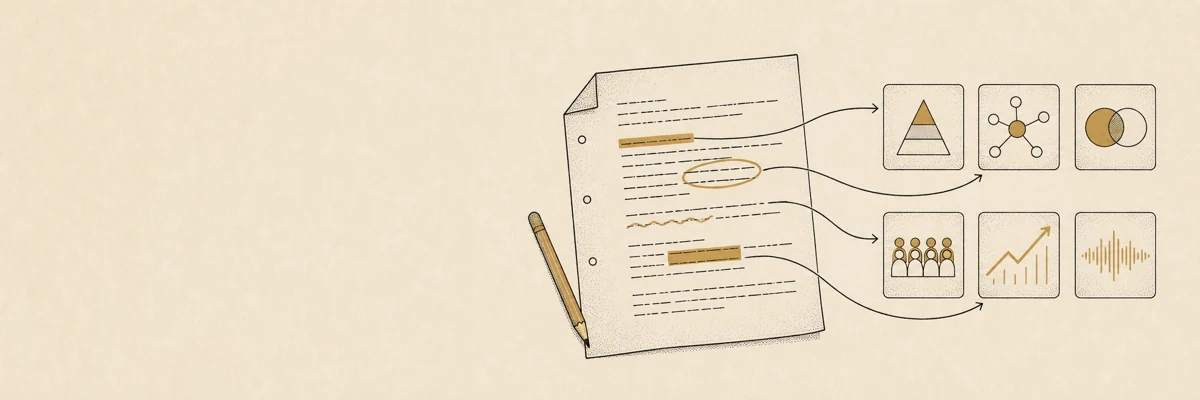
How your answers are scored
From the 2025 assessment schedule, in summary: each of the three questions is marked out of 8, for a total of 24. A score of 5–6 on a question is Scholarship level; 7–8 is Outstanding.
- Scholarship (5–6) rewards: factual accuracy; awareness of media history and current information; convincing knowledge of the question's territory; a coherent, well-structured argument that addresses the question and considers various perspectives; consistent links back to the chosen quotation; diverse evidence used convincingly; some insightful analysis; well-supported conclusions.
- Outstanding (7–8) adds: extensive and detailed knowledge, current and historical; awareness of probable future trends and their implications; independence, flexibility, and originality of thought; the ability to synthesise an overarching view of the topic.
Read the criteria as instructions. "Links between their response and the statement" means link back to the quotation throughout, not at the start and end. "Various perspectives" means build in a counter-argument. "Future trends" means the Outstanding move is often a final paragraph asking where is this heading?
Question One · media and wider society
"Old media is now scared stiff. They finally have figured out that they must adapt – or die." (Ted Gioia)
Step 1 — Unpack it
- "Old media" is doing the heavy lifting — and it's undefined. Broadcast TV? Print news? Radio? Record labels? Cinema? Your first job is to stake out what you take it to mean and defend the choice. The 2025 report singles out failure to define this term as the main reason responses fell short.
- "Scared stiff" / "finally figured out" — the quotation claims old media was complacent and is now reacting from fear, late. Do you accept that account of why it's adapting? There's an argumentative opening here most candidates missed.
- "Adapt – or die" — a stark binary. Is it true? Some media adapted (radio → podcasts and streaming apps), some died in form but survived by remediation, some persist unchanged in niches (print books, vinyl). The binary itself can be the thing you evaluate.
Step 2 — Thesis options
✗ Weak thesis
"Old media like newspapers and TV are struggling because of the internet, and this essay will discuss how they are adapting."
Why it fails: accepts every term uncritically, takes no position, promises description.
✓ Strong thesis
"Gioia is right that legacy media now adapts under existential pressure, but 'adapt or die' misreads the pattern: what dies is rarely the medium and never the demand — it is the business model. Broadcast television in Aotearoa shows all three fates at once: adaptation, remediation, and managed decline."
Why it works: agrees with limits, names a mechanism (business models, not mediums, die), defines its ground (NZ broadcast TV), and forecasts the structure.
Step 3 — A four-move plan
- Establish the fear, concretely. The measurable collapse of the old model: linear TV audiences and advertising migrating to platforms and streaming. NZ evidence is sharp here — recent newsroom closures and cutbacks make "scared stiff" literal. Theory: gatekeeping and the advertising filter (Chomsky & Herman) explain what's actually being lost.
- Test "adapt": who has, and how. A case of genuine adaptation — broadcasters building streaming platforms, radio becoming podcast networks. Theory: remediation — old media absorbed and refashioned rather than replaced.
- Counter-move: the binary breaks down. Media that neither adapted nor died (niche print, cinema's post-pandemic persistence), and "adaptation" that amounts to dying more slowly. This is where you argue with Gioia rather than illustrating him.
- Evaluate and extrapolate. Whose problem is this — media companies', or democracy's? End on the future-trends move the Outstanding criteria reward: if the adaptation logic continues, what does "old media" look like in ten years, and who funds the journalism?
From the 2025 report: this was one of the two most-chosen options and produced the best responses overall — including regular Outstanding awards for well-prepared candidates. But it also produced many Below Scholarship scripts: candidates who never pinned down "old media", or who asserted adaptation/decline without a theoretical or scholarly framework, relying on general awareness instead of specific study.
Question Two · media production
"'Make me care' – please, emotionally, intellectually, aesthetically, just make me care." (Andrew Stanton)
Step 1 — Unpack it
- Three registers, named. Emotionally, intellectually, aesthetically — the quotation hands you an essay structure. How did your production try to make an audience care in each register? Which did you prioritise, and why?
- "Make me" — caring is produced, not hoped for. It's the result of deliberate craft decisions. That's the production-context claim you must demonstrate from your own work.
- The implied audience. "Me" is a viewer pleading. Every part of your answer should stay anchored to a defined audience — the report is blunt that answers without one fail.
Step 2 — What the question requires (and weak answers miss)
Question Two always demands critical understanding of one medium and its production context, evidenced by your own production experience. The structure that works, for each decision you discuss: decision → reason (audience) → constraint → outcome → connection to professional practice — the same framework as the Production Reflection page. The fatal pattern, named in every report from 2023 to 2025: narrating the process ("we storyboarded, then filmed, then edited") instead of analysing decisions and outcomes.
Step 3 — A plan shape
- Position. Take a stance on Stanton's plea — e.g. "making audiences care is the entire job, and in my production every aesthetic choice was secretly an emotional one." Define your production, medium, and intended audience in two sentences.
- Emotional register. One concrete decision (casting, music, a held shot) made to produce feeling; the constraint that shaped it; whether it worked — with evidence from real audience response. Connect to a model text or named creator who solves the same problem.
- Intellectual / aesthetic registers. A decision that asked the audience to think, or a style choice that earned attention; same structure. This is where genre conventions, mode of address, and your medium's affordances do analytical work.
- The honest evaluation. Where you failed to make them care, and why — examiners consistently reward critical reflection on shortcomings over success stories. End by generalising: what your experience reveals about how professional media engineers care at scale.
From the 2025 report: this was the most popular Question Two choice, and over half who chose it (or the Malhotra "learning" quotation) earned Scholarship or higher — the successful ones gave detailed decisions with clear justifications, named their intended audience, evaluated outcomes, and referenced influences and model texts. The least successful Question Two answers that year described conventions or processes without justifying any choice.
Question Three · close reading of media texts
"Film-making [or other media productions] is a way of understanding the world." (Alice Rohrwacher)
Step 1 — Unpack it
- An epistemological claim. Media doesn't just depict the world; it's an instrument for understanding it. Your close readings must show texts producing understanding — of history, identity, power, fear — not just representing things.
- Understanding for whom? The maker (production as inquiry), the audience (texts as lenses), or the culture (genres as collective sense-making)? Choosing one — or arguing they're inseparable — is your thesis decision.
- The plural: "media productions". Question Three expects close reading across texts. The report is explicit that single-text answers, or scattered texts with no thematic connection, fail. Your texts need a connecting spine.
Step 2 — Thesis options
✗ Weak approach
A film-by-film tour: "Get Out shows racism. Parasite shows class. Both help us understand the world." Sequential summaries, token quotation references at the start and end.
Why it fails: this is exactly the pattern the 2025 report describes — descriptive, summary-driven, tenuously connected to the question.
✓ Strong approach
"Genre is how popular media thinks. Through close reading of [two or three connected texts], I argue social horror converts lived injustice into a form audiences can feel before they can articulate it — understanding the world precisely by deforming it."
Why it works: a clear claim about how understanding is produced, a connected text set, and a built-in role for formal close reading (the deformations are the evidence).
Step 3 — A plan shape
- Stake the claim. What kind of understanding your chosen texts produce, and through which formal means. Theory frame: Hall on representation as construction, or genre theory as collective sense-making.
- Close reading one. A specific sequence analysed at the level of camera, sound, editing — showing the mechanism by which form produces understanding. Production/release context included: who made it, when, under what pressures.
- Close reading two — extend or complicate. A second text that develops the argument (different era, different culture, or a text that fails to produce understanding — spectacle without insight — sharpening your criteria).
- Evaluate the claim itself. Limits of "understanding the world" through media: whose world, whose understanding, curated by what industry? Link back to Rohrwacher with a position you've earned.
From the 2025 report: more than half of all candidates chose this quotation. The successful ones had a clear thesis, integrated theory and critical perspectives, knew their texts' conventions deeply, and understood production context. The least-chosen quotation that year (Todd Haynes on identity) rewarded nearly everyone who picked it — well-prepared candidates writing about the representation of marginalised groups. The lesson repeats across years: the popular choice is not the safe choice.
Now study the real scripts
Read the 2025 exemplars — Scholarship, Outstanding, and Top Scholar — against the plans above and the P‑D‑M‑T‑E‑L framework. As you read, mark in the margins: where does the script link back to the quotation? Where does theory do work? Where is the counter-argument? Then do the same audit on your own practice essays.
Your turn: open the 2024 question booklet and run this same three-step process — unpack, thesis options, four-move plan — on one quotation from each question. Forty minutes total. That exercise, repeated weekly with different papers, is the single most exam-shaped training available.